
As the United States prepares to celebrate its 250-year anniversary since it declared independence on July 4, 1776, we’re looking back at the country’s varied history of immigration. The U.S. was founded on open borders for white Europeans, while simultaneously displacing hundreds of thousands of indigenous Americans and trafficking hundreds of thousands of enslaved Africans. The country has vacillated between periods of welcome for immigrants and refugees with periods of profound xenophobia and exclusion. Yet, over the centuries, the U.S. remains one of the most diverse countries in the world, with a large proportion of its population foreign-born.
As the world’s oldest refugee organization, HIAS has supported immigrants and displaced people in the U.S. for more than half of the last 250 years. Over the decades, we’ve seen the U.S. stand as a beacon of welcome for the tired, poor, and huddled masses. But we’ve also seen the U.S. turn away people desperately searching for safety, only to be sent back to their death. As we witness a resurgence in harmful policies towards refugees and immigrants, we will never stop fighting for a world in which all displaced people find welcome, safety, and opportunity.
Read on to learn more about U.S. immigration history, and HIAS’ work over the last century to help refugees and immigrants.
Give today
As the world's oldest refugee agency, HIAS will always stand for refugees — no matter who is president. And we will do all we can to support our clients, every day, as we have for more than 120 years. Give with confidence to HIAS.
Pre-1776: European Immigration and Forced Displacement of Indigenous Americans and Enslaved Peoples
Prior to the Declaration of Independence, European governments generally encouraged immigration to their fledgling colonies across North America. If Europeans had the means, they could emigrate to North America without many restrictions. However, many Europeans were also sent over with little choice after being convicted of a crime, a theme of forced migration that would mark both the colonial period and much of U.S. history.
At the same time, European governments encouraged the mass displacement of Indigenous Americans, killing millions via disease and violence, and forcing the survivors to leave their ancestral homelands for reservations in other parts of the continent, a practice that remained in effect for centuries. Beginning in 1619, hundreds of thousands of enslaved Africans were forced to migrate to North America. These legacies of forced displacement still haunt the U.S. today.
1776-1880: U.S. Expansion in Land and People
After the U.S. government formalized in 1789, Congress began creating laws around citizenship and naturalization. In 1790, the first law was passed establishing that only “free white persons” could become U.S. citizens. In 1798, Congress passed the Alien Enemies Act, which gave the federal government the right to detain and deport non-citizens during wartime, if they were deemed a threat.
In 1830, President Jackson signed the Indian Removal Act, which further displaced thousands of indigenous Americans within the U.S. The Mexican-American war in the mid-1840s resulted in the U.S. gaining significant land as well as as the citizenship of Mexican people who were already living there. After the Civil War, Black Americans were finally granted citizenship and birthright citizenship was established for people born in the U.S. Birthright citizenship later would help make the American dream possible for generations of immigrant families, whose children and grandchildren became Americans and helped shape the nation in return.
By 1880, immigrants comprised 13.3 percent of the population, similar to the percentage of immigrants today. The first major backlash to the changing demographics in the U.S. came with the Know-Nothing Party which arose in the 1840s and marketed itself as an anti-immigrant party in favor of white Christian nationalism.
During the first 100 years of U.S. independence, millions of immigrants arrived, with few barriers in their way. The majority came from Europe, but hundreds of thousands of Asian immigrants also arrived, primarily from China, and it was these immigrants who were first to be targeted by immigration restrictions.
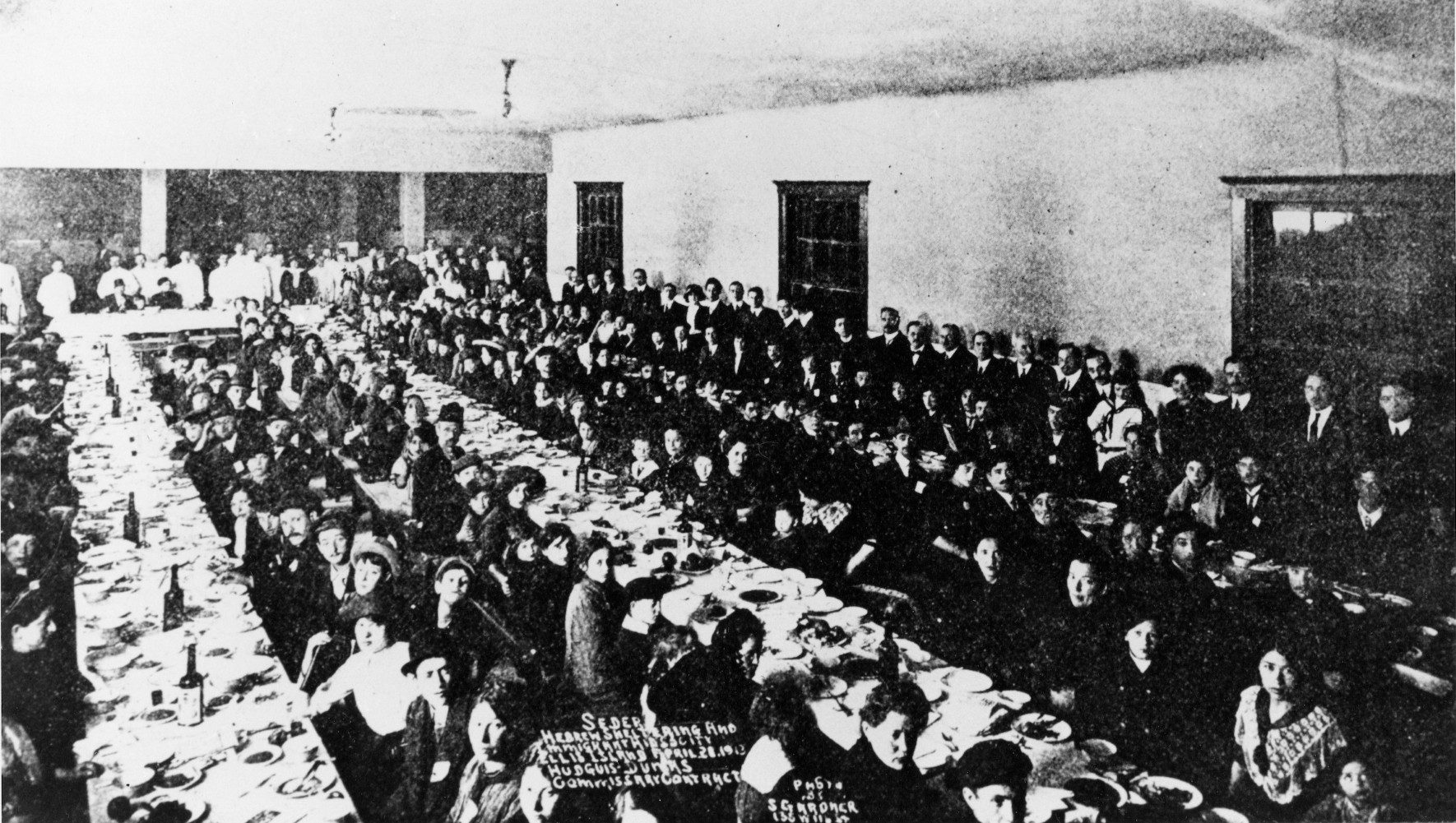
A Passover Seder organized by HIAS on Ellis Island, New York City harbor on April 21, 1913. (YIVO/HIAS)
1881-1920: Immigration Restrictions Begin and HIAS is Founded to Help Jewish Refugees
The Chinese Exclusion Act of 1882 was the beginning of a series of immigration laws that sought to curtail immigration to the U.S. At first, the laws targeted Chinese immigrants, but soon, Japanese and Korean immigrants were also targeted, and by the end of the 1930s, all Asian immigration was heavily restricted until the Immigration and Nationality Act of 1965.
In the 1880s, antisemitism and pogroms in Eastern Europe forced millions of Jews to seek refuge in the U.S. HIAS began working to assist arriving Jews, although the organization wasn’t formally incorporated as the Hebrew Immigrant Aid Society until 1903. While those arriving in the U.S. at that time were refugees, the world did not yet have a legal concept for people who needed safe refuge outside their homelands.
By the time Ellis Island became the official immigration processing station in New York City in 1892, HIAS had already begun providing meals, transportation, and jobs to members of the fast-growing Eastern European Jewish population. HIAS soon became famous worldwide as the organization founded by Jewish refugees to help other Jewish refugees.
Meanwhile, the Immigration Act of 1891 centralized immigration enforcement under the federal government and expanded the list of immigrants that could be denied entry. The Immigration Acts of 1903 and 1917 further banned immigration from most of Asia and the Middle East, raised the tax on admission, and instituted literacy tests.
More than 18 million people emigrated to the U.S. between 1890 and the end of World War I, primarily from Italy and Eastern Europe. The outbreak of World War I brought the largest influx of Jews from Eastern Europe yet: more than 138,000 arrived in the United States in 1914 alone. During this period, resentment against immigrants continued to rise, and there were campaigns to “Americanize” immigrants, including banning non-English language use.
1921-1950: Quotas, Detention, and Deportations Turned Away People Seeking Refuge
Shortly after the war, nativist politicians enacted restrictions limiting the number of immigrants to no more than two percent of the total of each nationality residing in the U.S. from the 1890 census. This severely limited the entry of any immigrants not from Western Europe, including Jews from Eastern Europe.
In 1924, Indigenous Americans were finally granted citizenship, the last group of people to gain the right created in the 14th Amendment of birthright citizenship. In the 1920s, the U.S. Border Control was founded at first to restrict Chinese immigration, but soon turned to rounding up Mexican immigrants, including Mexican American citizens, and deporting them to Mexico.
The number of immigrants into the U.S. dropped by 90 percent between 1924 and 1940. During this time of extreme restrictions, HIAS opened a European arm to support Jews in need who could no longer find safety in the United States. In the years to come, HIAS would help 250,000 men, women, and children escape Nazi persecution.
During World War II, few people could seek safety in the U.S. with its stringent immigration quotas. Additionally, 120,000 Japanese Americans were forced into internment camps, which have drawn comparisons to detention centers today. In 1943, the U.S. finally repealed the Chinese Exclusion Act, granting citizenship to Chinese Americans.
After World War II, HIAS was instrumental in evacuating the Displaced Persons camps in Europe and aiding in the resettlement of some 150,000 people to 330 communities in the U.S.
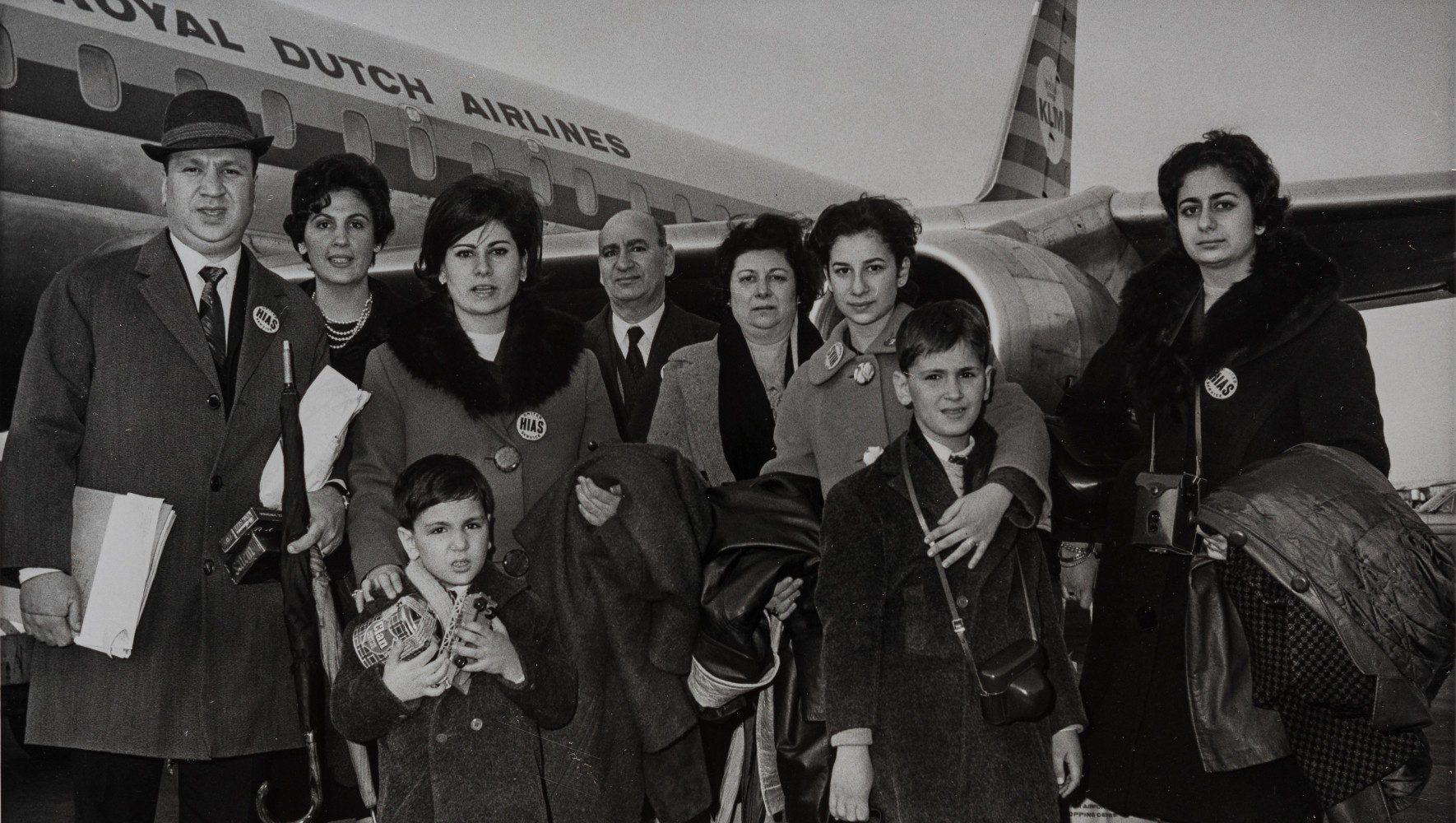
Jewish refugees arrive at JFK airport in New York City in the 1970s. HIAS has met countless refugees at docks, train stations, and airports to help them navigate their new countries.
1951-1970: The Refugee Convention and Landmark Immigration Reform
After World War II, and as a direct outcome of the world’s failure to protect those targeted in the Holocaust, the 1951 Refugee Convention became the basis for international refugee law, providing the foundation for HIAS’ future work to assist refugees around the world. While the U.S. did not immediately sign the Refugee Convention, it did begin to remove some immigration restrictions through a series of laws in the 1950s and admitted hundreds of thousands of refugees.
Because of labor shortages, the U.S. recruited 4.5 million Mexicans between 1942 and 1964 through the Bracero program. At the same time, “Operation Wetback” in the 1950s deported thousands of Mexicans.
More than 200,000 Cubans fled to the U.S. between 1959 and 1962, with HIAS assisting thousands of Cuban Jews. During the 1950s and ‘60s, HIAS also assisted Jews fleeing Hungary, Egypt, Algeria, Libya, Morocco, Czechoslovakia, and Poland.
In 1965, thanks to the strong advocacy of HIAS and others, U.S. lawmakers passed the Immigration and Nationality Act of 1965, which was a landmark piece of legislation that ended discriminatory quotas based on nationality, and instead created a more equitable immigration system that prioritized family reunification, skilled workers, and refugees.
1971-2000: The U.S. Refugee Admissions Program Is Established and HIAS Expands Its Mission
In 1975, the State Department requested HIAS’ assistance with the resettlement of Vietnamese, Cambodian, and Laotian refugees in the U.S. It was one of the first times HIAS assisted non-Jewish refugees. Soon, the Iranian Revolution led to HIAS facilitating the resettlement of thousands of Persian Jews with close family in the U.S. Starting in 1979, the Jews of the former Soviet Union found their way to freedom with the help of HIAS, with over 400,000 migrating to the United States and other countries.
In 1980, President Jimmy Carter signed the Refugee Act, codifying the right to asylum in U.S. law. The act also established a process of resettling refugees to the U.S. where the government worked in partnership with private resettlement agencies, including HIAS.
Three laws passed in the 1980s and 90s built upon the U.S. immigration system established in 1965. The Immigration Reform and Control Act of 1986 was the last major comprehensive immigration reform passed by Congress. It provided amnesty to thousands of undocumented immigrants already in the U.S. but also created restrictions when employing immigrants and increased funding for the U.S. Border Patrol. The Immigration Act of 1990 increased legal immigration ceilings, formalized skilled worker visas, and created Temporary Protected Status (TPS) to provide protection to people fleeing crises around the world. Finally, the 1996 Illegal Immigration Reform and Immigrant Responsibility Act expanded immigration enforcement and introduced expedited removal procedures.
America at 250: A Promise Worth Keeping
Read More2001-2025: Xenophobia and Immigration Restrictions Return
After the September 11 terrorist attacks, the U.S. passed the Homeland Security Act which changed immigration policy and enforcement, establishing three new agencies: U.S. Citizenship and Immigration Services (USCIS), U.S. Customs and Border Protection (CBP) and U.S. Immigration and Customs Enforcement (ICE). The Secure Fence Act of 2006 began a yearslong process of expanding physical barriers at the U.S.-Mexico border.
As Congress reached an impasse on passing any sort of meaningful reform, immigration policy moved more into the purview of the executive branch, with Presidents deciding to either erode immigrant and refugee rights or expand resettlement.
In 2012, the Obama administration created the Deferred Action for Childhood Arrivals (DACA) program which shielded the people who arrived as children from deportation. This program has been diminished by both Trump administrations.
Over the last decade, the Trump administrations have created severe restrictions on immigration and refugee admissions, with an intermission when the Biden administration reversed some of the policies, while continuing others. Restrictions have included a travel and immigration ban on people from certain countries, aggressive deportations of immigrants, the closure of protected pathways like TPS, the undermining of the right to asylum, and the gutting of the U.S. Refugee Admissions Program.
Even amidst this hostile environment, HIAS has never stopped working to help refugees and immigrants in the U.S. Buttressed by thousands of supporters across the country, HIAS is advocating for fair and humane immigration policies, while still providing vital services to refugees and displaced people.
Today: Refugee Resettlement, Right to Asylum, and Legal Immigration Under Existential Threat
Over the last year and a half, xenophobic policies have wreaked havoc on refugee and migrant communities. As we approach the 250-year anniversary of U.S. independence, HIAS’ effort to welcome the stranger and protect the refugee is more urgent than ever.
In every era, we have pivoted our work to meet the moment with expertise, resilience, and compassion. It is precisely this long history that makes us uniquely positioned to respond to the challenges of today. As we look to the next 250 years, we will never stop fighting for the rights of refugees and immigrants in the United States.
Give today
As the world's oldest refugee agency, HIAS will always stand for refugees — no matter who is president. And we will do all we can to support our clients, every day, as we have for more than 120 years. Give with confidence to HIAS.