Right now, refugees and asylum seekers in the United States are navigating a precarious landscape, where shifting policies and unpredictable systems undermine their safety. Many came to the U.S. seeking protection but now encounter daunting barriers, including shrinking legal pathways, complex bureaucratic hurdles, and limited access to secure housing. As they work to heal and rebuild, newcomers are increasingly vulnerable and unsure of what tomorrow will bring.
HIAS has fought for refugees for more than a century, but today’s situation is truly unprecedented. As domestic resettlement systems break down, the HIAS team is working around the clock, responding to emergencies, witnessing extreme hardship, and adapting in real time. Every hour brings new challenges, and HIAS refuses to let anyone face them alone.
The questions we hear are urgent: What do refugees and asylum seekers need right now? How is HIAS responding to immediate and critical needs? In the midst of chaos and uncertainty, HIAS delivers rapid, lifesaving support at every step, determined to meet the most pressing needs with unwavering dedication.
Donate today
Now more than ever, your support is needed to help refugees and displaced people rebuild their lives.
Who is HIAS helping right now if fewer refugees are arriving?
This is one of the most important questions people ask today. Even when refugee arrivals slow or pause, the need does not disappear; it shifts.
HIAS is still supporting displaced people in the United States, including:
- refugees and Special Immigrant Visa (SIV) holders who arrived recently and still need stabilization and support;
- refugees already in the U.S. who remain eligible for certain services for years — because rebuilding a life takes time;
- asylum seekers navigating a complex legal process and living in uncertainty;
- asylees who have been granted protection but need help accessing benefits and long-term stability;
- people in humanitarian protection programs (including Afghans and Ukrainians);
- and other vulnerable newcomers who fall outside “traditional” resettlement pathways but still need urgent support.
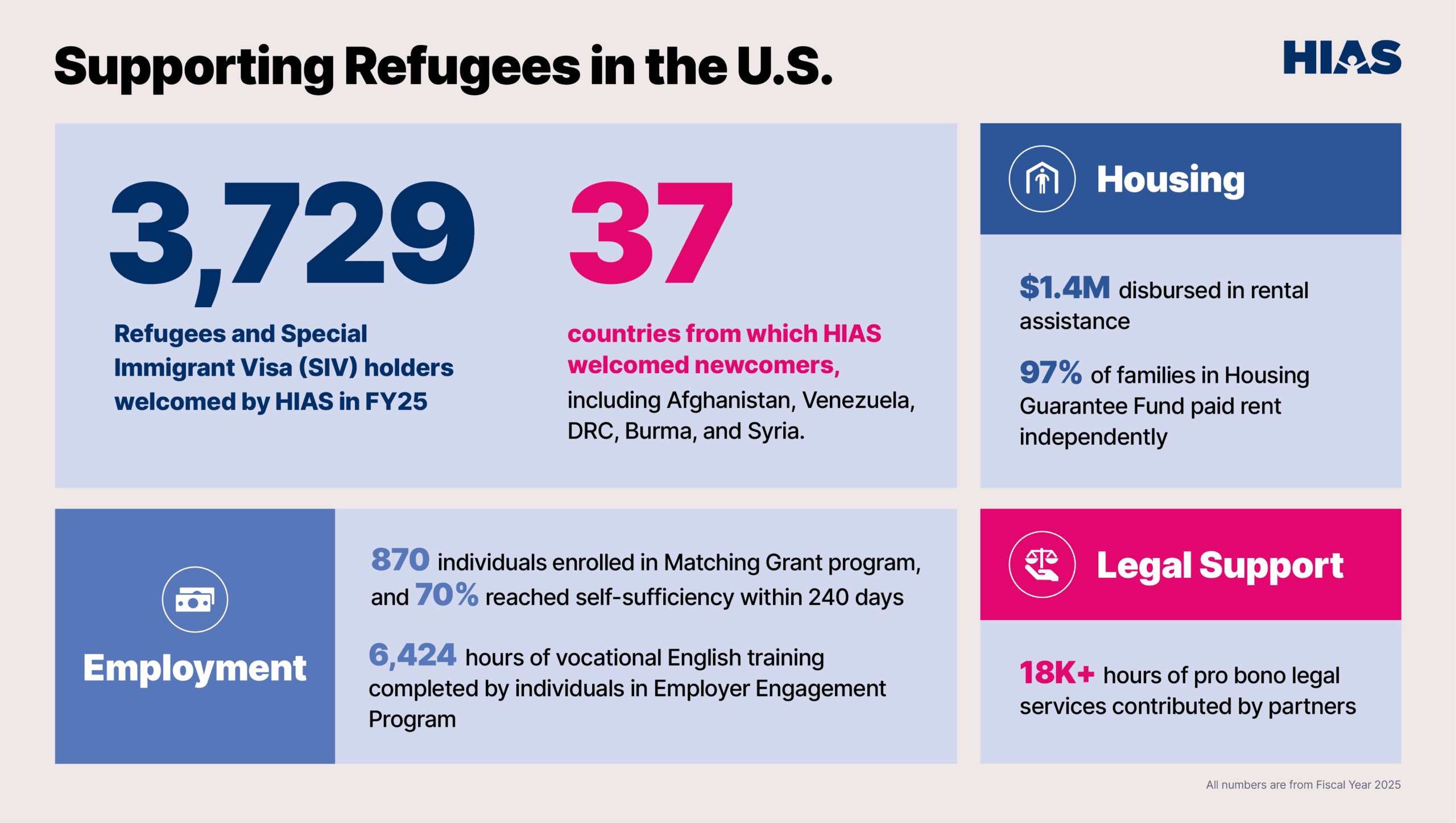
Despite every roadblock the Trump Administration threw at us to try to stop refugee resettlement, HIAS still welcomed in 3,729 refugees and Special Immigrant Visa (SIV) holders, including 1,545 Afghans during the last fiscal year. We also provided short-term case management to more than 6,000 displaced people and provided free legal representation to more than 1,300 refugees, asylum seekers, and immigrants.
What do refugees and asylum seekers need first when they arrive?
Refugees and asylum seekers need immediate assistance when they first arrive, including safe housing, food and essential supplies, medical care and health screenings, school enrollment for children, and transportation and community orientation. But these needs are quickly tied to often burdensome legal and administrative steps. Refugees and asylum seekers need assistance obtaining documents, applying for work authorization, navigating their eligibility for benefits, and understanding their legal obligations and rights. This is where HIAS’ trauma-informed case management becomes critical.
How does HIAS support refugees who arrive through the U.S. Refugee Admissions Program (USRAP)?
HIAS provides initial resettlement support for refugees and SIV holders through a national network of local partner organizations. In FY25, HIAS worked with 29 local affiliates across the country to provide comprehensive, trauma-informed services.
Initial resettlement support can include case management, cultural orientation, benefits and systems navigation, support accessing healthcare, school enrollment, and family reunification assistance; and employment readiness training and help securing employment.
What happens when refugee arrivals are disrupted or support systems are cut?
When resettlement systems are paused or defunded, the consequences hit families immediately.
Newcomers can lose caseworkers and vital guidance, financial support that prevents homelessness, structured orientation and safety planning, and critical services during their most vulnerable first months in a new country.
HIAS has responded by expanding programs that stabilize families quickly, especially housing support, community sponsorship, and virtual services that reach people wherever they live.
How does HIAS help newcomers find stable housing?
Housing is one of the biggest barriers for refugees and asylum seekers, especially for families who have no credit history, no rental history, limited income, or sudden changes in legal status.
HIAS operates multiple housing programs designed to prevent eviction and homelessness:
The Ms. L Settlement Housing Assistance Program
HIAS supports families who endured forced separation at the border and are rebuilding their lives after profound trauma. In 2025, HIAS provided critical housing support to 396 families (1,329 individuals) and disbursed $1.4 million in rental assistance.
The Housing Guarantee Fund
Newly arrived refugees are often denied housing because they lack Social Security numbers, credit history, or employment when they first arrive. In 2025, HIAS backed leases for 227 refugee families (877 individuals) and over 97% of families covered rent independently, using the fund primarily to qualify for housing.
Emergency Housing Assistance
In the past year, HIAS provided $135,000 in urgent rental aid to refugees and SIV holders, and our resettlement partners helped distribute funds to stabilize newcomer households.
What does “virtual resettlement” mean and why does it matter?
Not every newcomer arrives in a city with a resettlement office nearby. Some people reunite with relatives in smaller towns or rural areas, where services are limited.
HIAS’ Virtual Program for Initial Resettlement (PIR) program provides structured support remotely during a newcomer’s first 90 days in the U.S., including:
- help navigating documents and benefits;
- support with housing planning and stabilization;
- connections to health screenings, English learning, and employment readiness;
- and cultural orientation and integration support.
This model expands access to resettlement support across the country, regardless of zip code.
Remembering Who We Are: One Year of Fighting Alongside Refugee and Immigrant Communities
Read MoreHow does HIAS help refugees and other newcomers find jobs?
Employment is essential for stability, but finding work can be difficult in a new country, especially when policies shift and fear rises.
HIAS supports newcomers through multiple employment and career programs:
Matching Grant
This program helps newly arrived families reach self-sufficiency quickly through job referrals, budgeting support, and wraparound case management. From October 2024 through December 2025, HIAS enrolled 272 households (870 individuals) and supported a 70% self-sufficiency rate within 240 days.
Refugee Career Pathways
HIAS also helps internationally experienced professionals re-enter skilled work through coaching, credential evaluation, training support, and job readiness. In FY25, 57 clients participated, completing 1,333 hours of job readiness training and receiving direct financial support for education and career advancement.
Employer Engagement Program
HIAS partners with employers to create workplace-based training that builds English and job-specific skills. In 2025, 80 participants completed 6,424 hours of vocational English training across multiple sites.
Why are legal services so critical for refugees and asylum seekers?
For people fleeing persecution, legal representation can be the difference between family unity and separation, stability and detention, safety and deportation.
HIAS provides free legal services in two major ways:
Direct Immigration Legal Services (NYC and DC regions)
HIAS provides direct immigration legal services in the NYC and DC regions, assisting hundreds of clients with critical needs such as asylum applications, work authorization, green card processing, family reunification, and legal consultations. These efforts help newcomers navigate complex legal pathways and supported their integration and stability in the United States.
HIAS’ Pro Bono Network (nationwide)
Our Pro Bono network mobilizes volunteer attorneys to represent refugees, asylum seekers, and other displaced people navigating complex legal pathways. Pro bono partners contributed 18,000+ hours of legal services valued at $18.6 million in FY2025.
Seven Ways You Can Take Action for Immigrants
Read MoreHow does HIAS support mental health, family wellness, and long-term integration?
Resettlement isn’t only about survival. Many newcomers arrive after trauma and then face new stressors in the U.S.: isolation, uncertainty, discrimination, and fear.
HIAS supports long-term integration and mental health care through the Preferred Communities program, providing technical guidance and oversight to our resettlement partners nationwide. We provide:
- trauma-informed case management;
- culturally responsive group programming;
- extended cultural orientation;
- wellness and coping skills workshops;
- direct cash assistance for urgent needs;
- and training and oversight to ensure strong service delivery nationwide.
In FY25, our resettlement network served 1,093 clients through intensive case management and 2,600+ clients with direct cash assistance for urgent needs like housing, food, medical care, and transportation.
HIAS also provides wraparound social services for legal clients in the greater New York City and metro Washington D.C. areas, including case management, therapy, volunteer support, and benefits navigation. In 2025, HIAS social services served 182 clients with increasingly complex needs — expanding resilience workshops, safety planning, and partnerships to meet rising fear and instability.
How can I learn more about HIAS’ work in the United States?
HIAS’ U.S. programs span refugee resettlement, housing, legal services, employment support, integration, and community-based welcoming, all rooted in a trauma-informed, client-centered approach. And as the environment changes, HIAS continues to adapt, developing new resources, new models, and new partnerships to keep displaced people safe.
Get involved and help support our work at hias.org/take-action.
Donate today
Now more than ever, your support is needed to help refugees and displaced people rebuild their lives.