As we approach the midway point of the second Trump administration and the start of a new Congress, we are at a critical moment for refugee protection in the United States. The U.S. Refugee Admissions Program (USRAP) has been fundamentally dismantled, leaving thousands of people without the safety and stability they were promised.
Here’s where things stand, and what comes next.
How has the Trump administration targeted refugees?
On January 20, 2025, the administration sent an unequivocal message about their plan to undermine USRAP. Within hours of President Trump’s inauguration, he signed an executive order that indefinitely suspended refugee processing and admissions. Effective immediately, refugee arrivals stopped, and more than 100,000 people who were already vetted for admission to the U.S. were left stranded overseas.
Although the executive order allows for the possibility of exceptions to the ban on refugee arrivals, so far, nearly all of these have gone to white South Africans. Last year’s refugee admissions goal was ultimately set at 17,500 people, a historic low. The same is true for the current fiscal year.
To make matters worse, in a shocking turn of events, the Trump administration has systematically expanded its targeting of refugees to include weakening protections for those who are already here. In more than four decades since the formalization of USRAP with the passage of the 1980 Refugee Act, we have never seen anything like this before.
Give today
As the world's oldest refugee agency, HIAS will always stand for refugees — no matter who is president. And we will do all we can to support our clients, every day, as we have for more than 120 years. Give with confidence to HIAS.
Why is the U.S. government re-vetting resettled refugees?
The first strike came at the end of 2025 when United States Citizenship and Immigration Services (USCIS) announced that they would begin to re-vet and, in some cases, reinterview resettled refugees who were admitted into the U.S. during the Biden administration.
Then, the situation intensified in January 2026, with the launch of Operation PARRIS (Post-Admission Refugee Reverification and Integrity Strengthening). The Department of Homeland Security (DHS) claimed that this targeted refugee re-vetting program would help to address alleged fraud in USRAP but provided no public evidence to back up these claims. They focused their efforts on resettled refugees in Minnesota who did not yet have their lawful permanent resident status, resulting in people being arrested in their homes and then flown out of state to detention facilities.
Eventually, a District Court judge stopped the arrests and detention of refugees from Minnesota. Later, a federal judge ensured that the refugee detention policy could not be implemented anywhere in the country. However, the re-vetting and reinterview process continues, causing immense stress and instability in the lives of people who followed every rule and did everything asked of them before they were legally admitted into the U.S.
What is happening to refugees’ green card applications?
At the same time the administration announced its re-vetting plans, they also officially announced that they would no longer process or adjudicate green card applications for refugees who were admitted during the Biden administration. Keep in mind that according to U.S. law, refugees are required to apply for their green cards after one year. The policy places refugees in an impossible position: federal law requires them to apply for permanent residency, while the administration is refusing to decide their applications, yet reinterviewing and re-vetting them if they do not yet have their green cards.
In addition, last summer, Congress passed H.R.1, also known as the One Big Beautiful Bill (OBBB) Act, which cuts essential food and medical benefits to refugees if they do not have their green cards. Yet, of course, refugees who arrived during the Biden administration cannot avoid these massive obstacles because their green card applications are on hold. It is a twisted catch-22 that leaves refugees at risk for hunger, lack of access to medical care, and uncertainty about their futures in the very country that promised them permanent safety.
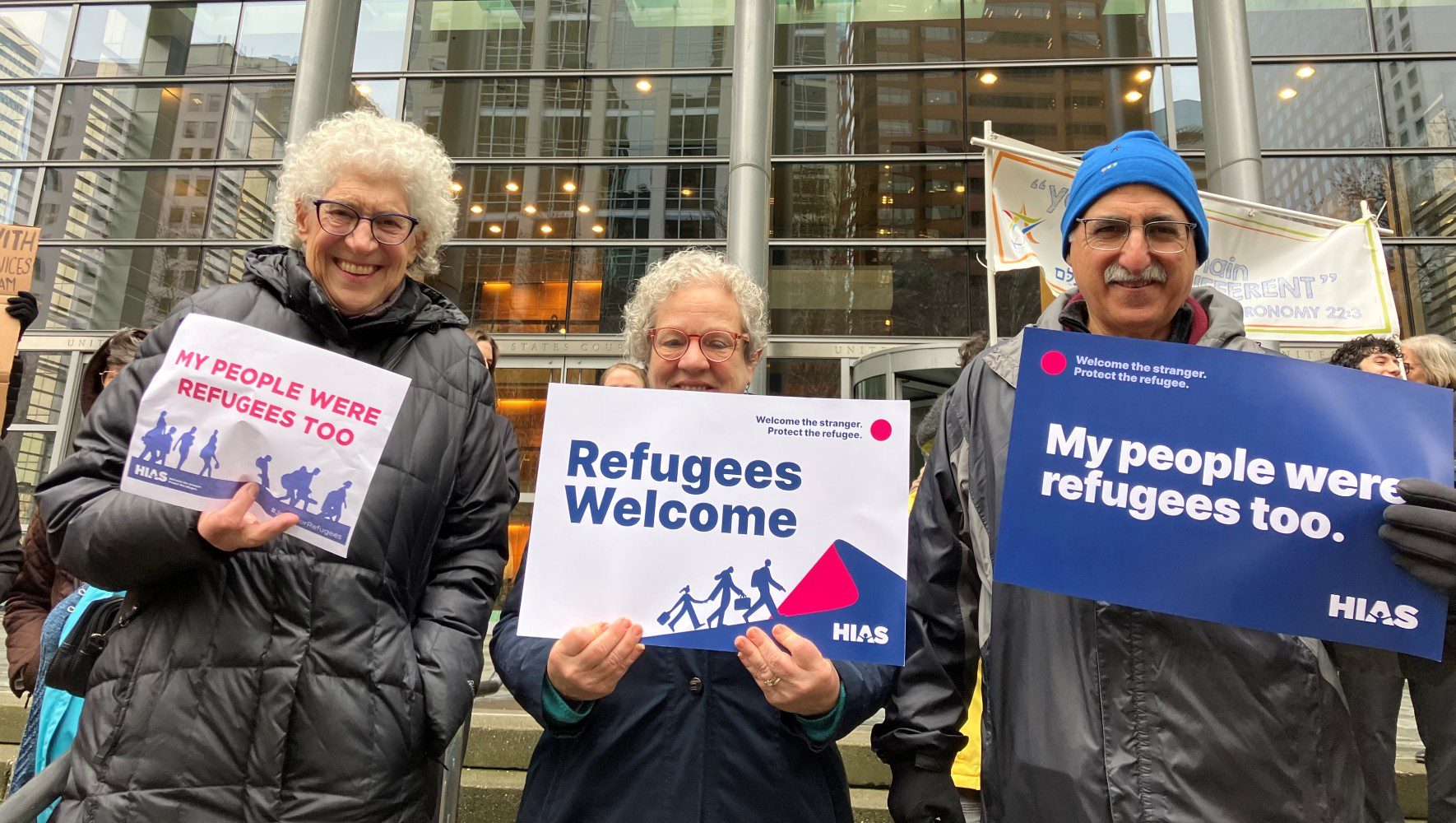
On the Offense: HIAS Files Multiple Legal Challenges to the Trump Administration’s Attacks
Read MoreCan the U.S. government take away someone’s refugee status?
On October 14, 2026, DHS issued a new rule that will make it dramatically easier for the Trump administration to terminate the refugee status of people who were resettled through USRAP and do not yet have their green cards, even though green card adjudications are on indefinite hold. The new policy is intended to reduce the number of days that someone has to challenge the administration’s effort to terminate their refugee status from 30 days to 10 days, making it essentially impossible for them to defend their status and why they should not quickly be removed from the U.S., and potentially sent back into harm’s way.
A federal court has put a temporary block on implementation following the filing of litigation by a group of individual refugees and several organizations, including HIAS. However, this pause is just effective through early December 2026, and we continue to look to the courts for a permanent termination of the rule.
How is HIAS fighting back against these anti-refugee policies?
HIAS immediately took our fight to the courts. We are a co-lead plaintiff in the Pacito v. Rubio case, challenging the ban on refugee arrivals. We are also a co-lead plaintiff in the recently filed PANA v. Edlow case which challenges the re-vetting, green card holds, and refugee status termination policies. In addition, we continue to educate lawmakers about what this administration has done to USRAP and the changes that must be made.
The U.S. made a promise of safety to refugees who followed every rule required of them. HIAS is fighting to ensure that promise is kept. Join us in urging lawmakers to restore a fair refugee admissions system and protect refugees who are already rebuilding their lives in the U.S. Learn more about how to take action with HIAS here.
Give today
As the world's oldest refugee agency, HIAS will always stand for refugees — no matter who is president. And we will do all we can to support our clients, every day, as we have for more than 120 years. Give with confidence to HIAS.